George McKay 1862 – 1915
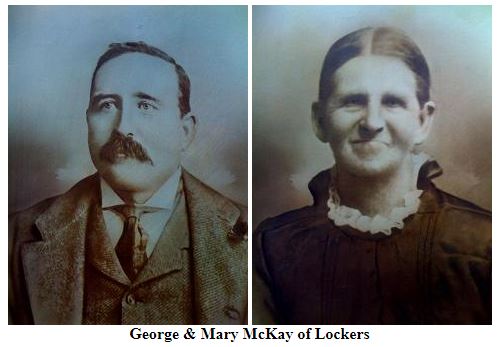
George McKay has the distinction of being the only member of the McKay family to have lived his entire life at Lockers, Newmill, Banffshire, a holding of approximately 13 acres (enlarged later with the addition of neighbouring crofts). Born there on 12th October 1862, the second son and youngest child of Peter McKay and Isabella Clark, he remained there until his death (also at Lockers) on 2nd May 1915, from Cystitis Pyelitis. In the 1871 census George is listed along with his parents and older sister and brother – Marjory born 1859 and William born in 1860, but by the 1881 census his mother Isabella was the head of the family, his father Peter having died in 1879 and his brother William having previously left home for Forres (to be a railway worker).
On 14th January 1882 George married Mary Granger Newlands (born in Colinton, Edinburgh in 1955) and they reared their numerous progeny at Lockers, his mother Isabella living with them until her death in 1894. After he himself died in 1915 his widow carried on at Lockers until the early 1920’s when she moved to the village of Newmill, sons Robert and later Alfred in turn taking on Lockers’ responsibilities.
Until comparatively recent times many small farmers and crofters could not rely solely on agriculture for their livelihood and were often engaged in additional employment, frequently leaving the family to carry on the cultivation or husbandry of the land and animals in their absence. These individuals thus provided the sort of essential services without which a rural community would founder i.e. that of the smith, the wright, the molecatcher, to name but a few. George McKay was one such farmer, in his case the subsidiary occupation being that of cattle and horse dealer – a vital role in an agricultural society.
In 1887, John Bartholomew’s Gazetteer of the British Isles described Newmill like this: New Mill, quoad sacra par. and vil., in par. and adjacent to Keith, Banffshire, on river Isla-par., pop. 1431; vil., 1¼ mile N. of Keith, pop. 651; P.O. Newmill is now part of MORAY Council.
George, on occasion, travelled far afield in pursuit of animals and is known, presumably exceptionally, to have gone as far North as Sutherland in search of suitable beasts. The usual historic practice was for the animals to be brought down over the ancient system of drove roads to be sold at trysts and fairs (marts or markets) all over the country but it’s certain that that was before George’s time. One of the biggest of these marts in George’s time may have been at Akey Brae in Buchan which was one of the few fairs to be attended by English buyers. In general the cattle side of the business was in decline by the last quarter of the 19th century and the trading at these fairs became mainly in horses. George McKay seems to have followed this trend as we are told that he originally dealt in cattle but latterly was known as a horse dealer as well as crofter.
George is also remembered as being the cause of a violent quarrel between his wife and the local priest (it is said that this was not unconnected with his immoderate drinking habits) and consequently severing his connection with the Roman Catholic Church. It is uncertain whether this was a permanent rift but it was at any rate the first break with the long tradition of Catholicism in the McKay family. As George died without making a will his widow had to go to court to have her claim to his estate ratified. An inventory of his property was made at that time:
Inventory of the Personal Estate of George McKay, Deceased. At Banff the 22nd day of June 1915, the following inventory of the Personal Estate of the late George McKay was presented for registration in this register conform to law by S.W. Mayer, Solicitor, Keith.
Inventory of the Moveable or Personal Estate and Effects, wheresoever situated of the late George McKay, Farmer, late of Lockers, Keith, who died at Lockers aforesaid on the 2nd day of May 1915.
- Cash in House £ 5. 0.0d
2. Value of Implements, crop, stock & other
effects as per valuation of Mr. R. Guthrie,
Licensed Appraiser, Keith £ 108.19.6d
3. Sum in bank, with interest to date of death, viz:
Cash in N. of S. Town & Country Bank, Moss St.,
Keith, on Deposit Receipt, dated 27th Oct. 1913 £ 55.0.0d
Interest thereon to date of death £ 1.17.0d
4. Three £1 shares of the Central Banffshire Auction
Mart Co. Ltd., Keith valued at £ 1.10.0d
Total estate value: £ 172. 6.6d
On 21st June 1915 Mary was confirmed as his legal executrix and the following is an extract of these proceedings:
“At Keith the 21st day of June 1915 in presence of James Johnstone Gray, Esquire, One of His Majesty’s Justices of the Peace for the County of Banff, Appeared Mrs. Mary Newlands or McKay, Widow, Lockers, Keith, who being solemnly sworn and examined, Deponed That the said George McKay died at Lockers aforesaid on 2nd May 1915 and had at the time of his death his ordinary or principal domicile in the County of Banff in Scotland. That the Deponent is the Widow of the Deceased.
That the Deponent has entered, or is desirous of entry, upon the possession and management of the Deceased’s estate as Executrix aforesaid. That the Deponent does not know of any testamentary settlement or writing relative to the disposal of the deceased’s Personal or Moveable Estate or Effects, or any part thereof …..
That Confirmation of the Personal or Moveable Estate is required in favour of the Deponent. All of which is truth, as the Deponent shall answer to God.
Signed Mary McKay
J.J.Gray, J.P.
Mary Granger Newlands
Mary was born on 24th October 1855 in Slateford, then a village outside Edinburgh in the parish of Colinton. (Virtually nothing now remains of the old village, which took its name from the type of rock which formed a ford across the Water of Leith. Today Slateford is a semi-industrial suburb of Edinburgh.) She was the eldest child of James Newlands and Christina Dickie, who had been married the previous year at Keithhall, Aberdeenshire.
At the time of her birth Mary’s father was a County Police Officer, although in later years he became a shoemaker. The family had returned to his home village of Botriphnie, Banffshire by 1859, where they lived at Porter Lodge and subsequently at Tenrood. By 1871 Mary had left her family and the next record we have of her is not until 1881 when she was living (in service as a domestic servant) at a farm called Followsters, outside Newmill, also in Banffshire.
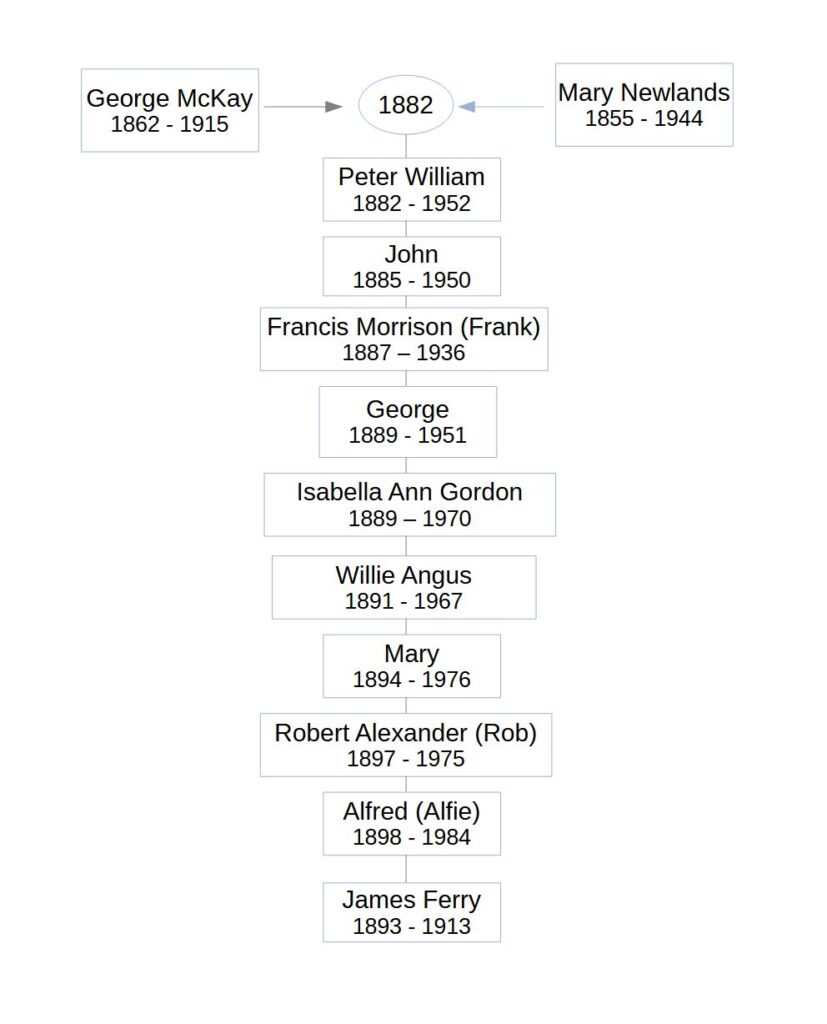
Shortly after, on 4th January 1882 she married the younger son of the neighbouring property, George McKay – a husband who was her junior by seven years. For the first twelve years of her married life Mary shared the house at Lockers with her widowed mother-in-law and she also nursed her sister-in-law, Marjory Ferry (known as May), who died there of consumption in 1892 aged 34. George and Mary had a large family of eight sons and two daughters, all of whom were born at Lockers. They were Peter, John, George, Isabella, Francis, William, James, Mary, Robert and Alfred. The youngest and last surviving member of this family, Alfred, died at Elgin on 24th April 1984 aged 85.
After her husband’s death in 1915 Mary carried on farming at Lockers. On the marriage of her son Robert in the early 1920s she moved to Newmill and lived there until she died in March 1944. She was then aged 88. Mary is buried at Keith alongside her husband George and two of their sons, James who died in 1913 aged 30, and George who died in 1951 aged 67.
Links to George and Mary’s children (the links are work in progress, not necessarily all active yet):-
- Peter William McKay b. 1882, Keith – d. 1952, Aberdeen
- John McKay b. 1885, Keith – d. 1950, Keith
- Francis Morrison McKay b. 1887, Keith – d. 1936, Drumblade, Huntly
- George McKay b. 1889, Keith – d. 1951, Keith
- Isabella Ann Gordon McKay b. 1889, Keith – d. 1970, Aberdeen
- Willie Angus McKay b. 1891, Keith – d. 1967, Carluke
- Mary McKay b. 1894, Keith – d. 1976, Aberdeen
- Robert Alexander McKay b. 1897, Keith – d. 1975, Saskatchewan
- Alfred McKay b. 1898, Keith – d. 1984, Elgin
- James Ferry McKay b. 1893, Keith – d. 1913, Keith
Memorium Poem To George
Handed down to the author by a McKay cousin, this short but well-constructed poem is a tribute to his Great Grandfather George McKay of Lockers Croft by someone who was clearly a good friend (R. Leslie Moir), with a keen sense of spirituality.
IN MEMORIAM – Mr. George McKay of Lockers, passed away at Glen of Newmill on Sunday 2nd May (1915):-
Farewell, friend George, your race on earth is run,
No more your stalwart form shall tread our streets.
No more towards the Glen at set of sun.
Your sun-brown, weather-treated visage meets
The neighbour's cheery nod, or gladly greets
The housewife's smile, or watch-dog's deep-mouthed bay;
Old friend, your old friend's heart still kindly beats
In memory of a byegone day
That you and I together spent: now gone for aye!
And yet, friend George, in some strange, unknown hour
Once more your honest hand may clasp my own!
Some day the great unfathomable Power
That keeps the living and the dead in tone,
Will guide me on the same path you have gone,
And take me safely o'er the silent Bar,
that Bar which mortal man must cross alone!
To regions where dim eyes grow clearer far,
And I shall know you, old friend, as you are.
R. LESLIE MOIR.
Turner Hospital, Keith
Click for more detail…
According to the National Records of Scotland, a certain Robert Leslie Moir was born in Keith in the year 1867. No additional information is yet known about the friendship at this time or, indeed, if this was the very same Leslie Moir although it seems fairly likely that it was.
Family history has a way of being lost if not passed down over the years. Research has uncovered a number of items in general, but George may have been a colourful character beyond the bare facts. For example, the story goes that the McKays from Glenlivet were Roman Catholic in faith and evidence clearly supports that. George and Mary’s marriage took place at Lockers Croft, the marriage record being annotated “After Banns According to the Roman Catholic Church”. There is a story that we (Bill’s branch of the McKay family that is – others may well be different) were Catholic until the point in time where the priest was chased down the road from Lockers croft by Mary because the priest, clearly on a pastoral visit(?) chose to berate George – it has been said for possible liberal drinking habits – and for non-attendance at Church.
In 1887, John Bartholomew’s Gazetteer of the British Isles described Newmill like this: New Mill, quoad sacra par. and vil., in par. and adjacent to Keith, Banffshire, on river Isla-par., pop. 1431; vil., 1¼ mile N. of Keith, pop. 651.
Click for help on what the above means …
Quoad Sacra parishes are defined to exist for religious rather than civil purposes, based on the geographical area served by the church. The town of Keith sits on the river Isla and I think this tells us that in 1887 its population numbered 1431, and that the village of Newmill is 1¼ mile N. of Keith, at that time of population 651.
Mary Granger Newlands Ancestry
James Newlands 1827-1911 (Father)
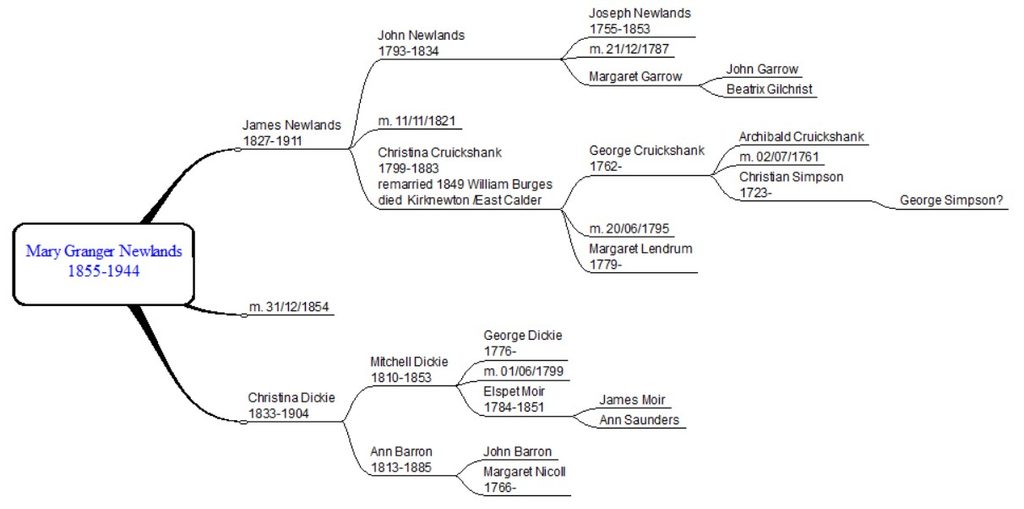
James was born on 12th August 1827 at Broomhill, Botriphnie, Banffshire. He was the fifth child of John Newlands, a handloom weaver, and his wife Christian Cruickshank. The sponsors at his baptism were James Innes and Helen McWillie. James’s father died at an early age, leaving his mother with a family of six young children to bring up.
James’s first marriage was at Rayne, Aberdeenshire, thus:
“James Newlands in Culsalmond and Margaret Boddie on Badyquath having been duly proclaimed were married in this church 8th December 1849.”
Margaret was a dressmaker from Fyvie and two children were born to them there – James around 1850 and Isabella two years later. Margaret, with her young Son, was listed at Baldyquath, Fyvie, the home of her mother (Jane Milne or Boddie) in 1851, but James was not at that address on the night of the census. Unfortunately the Fyvie parish registers do not mention the family at all.
The assumption is that Margaret died some time after the birth of her daughter in 1852 (it is thought in fact to be 1854), as James then married Christina Dickie on 31st December 1854 in the parish of Keithhall, Aberdeenshire. The exact location is not known, nor do we know which of the two (if not both) was resident there at the time. It is of interest that this marriage took place on the last day before civil registration of births, marriages and deaths became compulsory in Scotland.
At the time of the birth of the first child of this second marriage James was serving as a County Police Officer in the Village of Slateford (now a suburb of Edinburgh). The next child was born after the family had moved into Edinburgh, when they were living at 59 Fountainbridge. At this point James was no longer with the Police. By the time their third daughter arrived in 1859, they had returned to Botriphnie and in 1861 were to be found at Porter Lodge, Botriphnie, where the household consisted not only of James and Christina and their five children, but of six boarders also.
Although still at Botriphnie ten years later in April 1871, the address there was given as Tenrood and James’s occupation as book canvasser. Between then and the birth of Benjamin in September 1872 they had gone to live in the village of Fife Keith – now part of Keith.
James and Christina were living at 62 North Road, Forres at the time of her death in January 1904, when James was described as a retired shoemaker. He spent his declining years in Stonehaven, Kincardineshire, where he died in January 1911. James is still spoken of as having been of a somewhat feckless disposition and Christina used to relate to her family that on her way to church to be married a thorn had become caught in her skirt – and it has been there all my merried life!”. James’ death record describes him as a ‘Pauper of Keith’ married to Christina Dickie having died of senile decay in the ‘Combination Poorhouse’, Stonehaven.
John Newlands 1793-1834 (Father’s Father – Grandfather)
John Newlands was a son of Joseph Newlands and Margaret Garrow and was born at Newburgh, Botriphnie, Banffshire on 16th January 1793. The sponsors at his baptism were John Garrow, Elder and John Garrow, Younger; presumably relatives of his mother.
The next reference we have to John is when he married Christian (or Christina) Cruickshank, also of Botriphnie, on 11th November 1821 – viz the the following entry in the Old Parish Register for Botriphnie; “Appeared this day before the session John Newlands and Christian Cruickshank both in this parish, and was absolved and married after paying the penalty.” The absolution before the marriage clearly relates to the fact that Christian was around six months pregnant at the time.
John, who was a handloom weaver, and Christian had six children in quick succession between 1822 and 1830, all being born at Broomhill, Botriphnie.
As Christian was living at Broomhill with her father-in-law Joseph Newlands in 1841 and is known to have subsequently remarried, it is supposed that John died some time between 1830 and 1841. As their family ended abruptly with the birth of the sixth child Anne in 1830, it seems likely that John’s death took place around that time.
Although the family no longer appears to be represented in the Botriphne area, a William Newlands who died in 1945 and who was buried at Enzie, was described as being of Mossend, Botriphnie. This could be the William who was living at Tombreck, Botriphnie in 1912.
Joseph Newlands c1755-1853 (Father’s Father’s Father – Great Grandfather)
Joseph was born in Boharm parish, Banffshire, around the year 1755. Although we have gleaned the place and approximate date of his birth from later census returns, unfortunately no information on the Newlands family is given in the Boharm records, so no further light can be thrown on them. The first concrete proof of his existence comes in the following entry in the Cairnie Old Parish Register:
“21st December 1787 Joseph Newlands and Margaret Garrow both in this parish contracted and consigned pledges.”
A search of the registers for Cairnie, Aberdeenshire has been similarly unproductive with no earlier mention of either Newlands or Garrows. The couple however turn up again in Botriphnie where their son John was born in 1793. Joseph, who it seems was a crofter cum weaver (two occupations which were frequentiy combined), outlived his wife as he was still to the fore in 1841 at Broomhill, Botriphnie. By that time he was living with his widowed daughter-in-law, Christian Cruickshank. Then his age was given as 80-85 and, somewhat surprisingly, he was still crofting. He featured also in the 1851 census, again at Broomhill, but by then Christian had remarried and he was designated as the lodger of Adam and Jannet Brouster. He was then recorded as being ninety six years old.
Margaret Garrow (Father’s Father’s Mother – Great Grandmother)
As is the case with her husband, Joseph Newlands, nothing is known of Margaret’s early life and background. Although she was living at Cairnie, near Huntly, when she was married there, the Cairnie records yield up no further information on her or her family. Nor can we learn her place or date of birth as she does not appear in any census or other source so far consulted.
At any rate, Margaret, whatever her age and origins, was married to Joseph Newlands at Cairnie on 21st December 1787, and their one child known to posterity, John, was born at Newburgh, Botriphnie on 16th January 1793. The sponsors at his baptism were John Garrow, Elder and John Garrow, Younger, and this suggests that the Garrow family did have connections with Botriphnie. Although Margaret’s birth is not recorded there, Garrow was not an uncommon name in the area. As she was not mentioned in the 1841 census and Joseph was listed with his daughter-in-law, Margaret is presumed to have died by then.
Margaret’s parents were (as yet not fully confirmed) thought to be John Garrow and Beatrix Gilchrist.
Christian Cruickshank 1799-1883 (Father’s Mother – Grandmother)
Christian (or Christina) Cruickshank was the third of nine known children of George Cruickshank and Margaret Lintram or Lendrum. She was born at Upper Towie, Botriphnie, Banffshire on 8th September 1799, the sponsors at her baptism being Christian Humphrey and John Garden. She was married to John Newlands, a handloom weaver, also from Botriphnie, on 11th November 1821. John died in 1834, and Christina remarried in 1849 to William Burgess. In 1881 she resided in Kirknewton and East Calder district, Midlothian, which is where Christina passed away in July 1883. Kirknewton and East Calder incidentally is perhaps less than a 10 minute drive from Kirkliston where the website author, Bill, has lived since 2003.
John and Christina had six children – George born 1822, John 1823, Margaret 1824, Joseph 1826, James 1827 and Anne in 1830, all of these births being at Broomhill, Botriphnie. It appears that Christian was widowed around the time that her daughter Anne was born (otherise the likelihood is that she would have produced many more babies) although we do not know the exact date.
In the 1841 census Christian was living at Broomhill with her father-in-law, Joseph Newlands (doubtless by then a widower), along with her youngest child Anne. However by 1851 she had married for a second time; this time to William Burgess, a widowed farmer some twenty four years older than she. They lived at Braehead Cottage, Botriphnie with two of Christian’s grandchildren, Jane and Joseph Newlands. William also belonged to Botriphnie.
By the time of the 1861 census Christian was once more a widow, and working a seven acre holding at Blackhillock, Botriphnie.’ Her grand-daughter Jane was still with her and had been joined by another grandchild, Mary Masson, who like Jane had been born in Mortlach. The household also included five male boarders.
Some time before 1881 Christian left Banffshire and spent her last years with her second son, John, and his wife and family at Kirknewton, Midlothian, where she died on 18th July 1883. The address was given as “South side of street.”
George, her eldest son, remained at Broomhill, Botriphnie, being listed there as a master shoemaker with five acres of land in 1861. The valuation of his holding was assessed at £6.7/- in 1877. John, also a shoemaker, settled in Kirknewton and married a local girl, Mary Granger: He died there in 1886.
James seems to have had a varied career, having been a police officer, book canvasser and shoemaker at different times in his life. The first child of his second marriage was called after son John’s wife – Mary Granger Newlands.
George Cruickshank 1762- (Father’s Mother’s Father – Great Grandfather)
George was born on 16th April 1762 in Botriphnie, Banffshire, the eldest of the three known children of Archibald Cruickshank and his wife Christian Simpson. He married Margaret Lintram (Lendrum) and it was duly recorded in the Botriphnie register:
“1795 20th June George Cruickshank and Margaret Lintram both in this parish were this day contracted in order to marriage, consigned pledges for performance and were married 20th June. “
These pledges were sums of money left with the kirk session by those intending to marry and were redeemed after the marriage. If this did not take place then the party who had defaulted forfeited their pledge and the money went into the poor-box. Sometimes the less well-off deposited small pieces of jewellery or other articles which they valued, rather than actual cash. In some places the pledges were returned only if the first child was born at least nine months after the wedding.
Nine children resulted from George and Margaret’s union, all born in Botriphnie, although the specific locations varied. The first two were born at Towie, the following two at Upper Towie and the final five at Braidrashes.
There is no record of either George or Margaret in any of the local census returns so we can but conclude that they were both dead by 1841.
Margaret Lintram (or Lendrum) 1779- (Father’s Mother’s Mother – Great Grandmother)
We have no dates for Margaret other than those of her marriage and the births of her many children. From her husband’s age and the year of their marriage it could be thought that she had been born between 1765 and 1775.
Although when she married she was recorded as being of Botriphnie, there is no mention of any other Lintrams or Lendrums in the Botriphnie records, so perhaps she was an incomer to the district. She married George Cruickshank there on 21st June 1795 and their family was as follows: Jean born 1796, Margaret 1797, Christian 1799, Archibald 1802, Elisabeth 1804, George born 1806 and who did not survive as a second George appeared in 1808, William born 1810 and James 1814.
No further reference to Margaret has surfaced but neither she nor her husband seem to have been alive by 1841.
Archibald Cruickshank (Father’s Mother’s Father’s Father – Great Great Grandfather)
The Old Parish Records for Keith give the following information:
“19th June 1761 Archibald Cruickshank in Botriphnie and Christian Simpson in this parish were contracted, consigned pledges, proclaimed and married 2nd July.”
Archibald is likely to have been born in the 1720’s or 1730’s but his birth has not been traced. He and Christian had three children registered in Botriphnie – George, Margaret and James, the latter being born at Mill of Towie. They evidently remained in those parts as both of their sons married and raised families in the Towie area.
Botriphnie itself is a small rural parish of 9,500 acres, lying amongst the hills of Strathisla and straddling the Keith-Dufftown road.
Christian Simpson 1723- (Father’s Mother’s Father’s Mother – Great Great Grandmother)
Although at the time of her marriage to Archibald Cruickshank at Keith in 1761 Christian is described as being of
the parish of Keith this is in fact the only substantiated reference to her in the Keith records. The following entry does however appear for the 1723 baptisms:
“Christian lawful daughter to George Simpson in Nether Auchindachy. Witnesses John Simpson and Robert Kerr, Christian Glashan in Upper Auchindachy.”
It will be seen that the earlier the entry the less information is given. The mother was frequently not considered as being noteworthy, with only the father’s name being stated.
If these two Christians are one and the same (and one possible indication that this may be so is the naming of Christian’s first son as George) then it would mean that she was in her late thirties when she married. This of course is entirely possible and could account for the fact that she seems to have had only three children, an unusually small family for the times. Another explanation for this could be the early death of either husband or wife. At any rate, George was born 16th April 1762, Margaret 17th September 1763 and James 21st January 1767, all at Botriphnie.
Christina Dickie c1833-1904 (Mother)
Christina (or Christian) Dickie was the daughter of Mitchell Dickie and Ann Barron and was born in Chapel of Garioch, Aberdeenshire around 1833, although the precise date has not come to light. She married James Newlands on 31st December 1854 in the parish of Keithhall, Aberdeenshire.
Had this wedding taken place one day later, on 1st January 1855, it would have been among the first to be recorded in the compulsory national registration of births, marriages and deaths which came into effect in Scotland on that date. This replaced the old system of separate records being kept, with varying degrees of consistency, by the individual parishes of established churches, and for the first time included the many dissenting and non-conformist denominations who frequently had not kept records of any kind. The new system was a great improvement on the haphazard methods employed by earlier generations, and no longer depended for accuracy on the whims, conscientiousness and sometimes sobriety of the ministers and clerks concerned.
Christina was in fact James’s second wife and she acquired not only a husband but an instant family, in the shape of James and Isabella, aged four and two years old respectively. She then went on to produce a further eleven children, thus: Mary, born in Slateford in 1855, Ann born in Edinburgh in 1857, Christina 1859, Margaret 1860, Elisabeth 1862, Helen 1865, John 1866, Charles 1868, William 1870 (all in Botriphnie), Benjamin 1872 and Mitchell 1876, both born in Fife Keith.
It has been suggested that there was yet another child – Robert – but available information points to his being the natural son of James and Christina’s daughter Elisabeth by James Cook, and thus the Newlands’ grandson rather than their own child.
Whilst no attempt has been made to trace the subsequent history of any of the thirteen children who made up this Newlands family (other than that of Mary Granger) some information has been provided by one of Mary’s grand-daughters on those whom she remembers. Ann married William Young and went to live in Macduff, Christina (Kirstie) became Mrs. Howie and settled in Dufftown although she was much travelled for her day and visited Canada at one time. Margaret (Maggie), whose married name Was Smith, left the area and lived in Broughty Ferry in Angus, and Elisabeth (Lizzie) married James Gray and lived in Keith. One of Lizzie and James’ children was Hebbie Gray who became a well known and talented Northeast musician (a fiddler like his older cousin Roger McKay, father of the website author Bill) and music teacher around Banffshire and Morayshire, and made regular television appearances on what was then, in the 1960s, Grampian Television. Hebbie and his wife Shona Ross maintained the Roman Catholic faith and married at the RC chapel in Keith in 1959.
Mitchell, the second youngest of this large brood, is thought to have been employed by one of the railway companies in the Glasgow area.
Mitchell Dickie 1810-c1853 (Mother’s Father – Grandfather)
Nothing is known about Mitchell’s background other than that he was the son of George Dickie and Elspet Moir and had been born at Tulloch, Midmar, Aberdeenshire:
“18th May 1810 George Dickie and his wife Elspet Moir on Tulloch had a son named Mitchell.” (Midmar O.P.R.)
The farm of Tulloch lies on the lower slopes of the Hill of Fare and enjoys a fine open outlook over Cluny and Monymusk to the distant prospect of Bennachie. As there are no other births recorded for this couple in Midmar it is presumed that they did not remain there for any length of time.
It has not come to light when Mitchell married Ann Barron but Christina, the oldest of their recorded family, was born in 1833 approximately. As Mitchell and Ann’s youngest child, Margaret, was born in 1851 and he was dead by 1855, his death must have taken place some time between those two dates. He would have been in his early forties when he died and was survived by his widow for more than thirty years.
Mitchell appears to have been an agricultural worker and his Christian name was perpetuated in the naming of his grandson, Mitchell Newlands, one of the five sons of his daughter Christina.
Ann Barron c1813-1885 (Mother’s Mother – Grandmother)
Even less is known of Ann Barron’s background and this is not helped by the omission of the mother’s name on her death registration in 1883.
As her age at the time of death is given as seventy two we can surmise that she was born around 1813 – if in fact this given age is correct. We have no idea of when or where she married Mitchell but the only children of this couple who have been identified so far were all born in Aberdeenshire. They are three daughters – Christina born c1833 in Chapel of Garioch, Beattie born 19th October 1835 in Keithhall/Kinkell, Margaret born 1851 in Inverurie, and one son William, who was born on 20th May 1848, also at Inverurie.
Christina in due course married James Newlands, and Margaret married John Bruce, a farmer of Arnhead, Auchterless, Aberdeenshire. No further details are known of the others. Ann died at Arnhead on 12th May 1885 when her ‘usual residence’ was given as Greenden, Brechin. This address has not however been found in any census return.
George Dickie 1776- (Mother’s Father’s Father – Great Grandfather)
George is a figure about whom very little is known. He married Elspet Moir in Kintore, Aberdeenshire in 1799: “1st June 1799 George Dickie in the parish of Keithhall and Elspet Moir in this parish consigned pledges and being regularly proclaimed were married 18th. Witnessed by John Moir and Andrew Moir.”
A search of the Keithhall records has drawn a blank, there being no-one of the name of Dickie mentioned. Of this couple’s four known children, the first was born at New Machar, the second and third at Skene and the last at Midmar. As only passing references to George and Elspet have been found in several different Aberdeenshire parishes the likelihood is that they moved around from place to place. This suggests that they had no land or holdings of their own and were dependant on others for employment.
Elspet Moir 1775- (Mother’s Father’s Mother – Great Grandmother)
The parentage of Elspet is questionable despite the fact that there was a child of that name born to James Moir and Ann Saunders in the parish of Keith at an appropriate date (11th June 1775), as there is nothing to substantiate the theory that they were one and the same person.
Elspet married George Dickie on 18th June 1799 in Kintore, where she was resident, whilst George was living in Keithhall at the time. The witnesses to the marriage were John and Andrew Moir so perhaps her family was established in the vicinity. The Old Parish Register for Midmar, Aberdeenshire contains:
“18th May 1810 George Dickie and his wife Elspet Moir on Tulloch had a son named Mitchell.”
he being the fifth of their seven recorded children. The others were Margaret born 22nd March 1800 at New Machar, James born 15th April 1804 at Skene, and Andrew born 20th July 1806, also at Skene, Jean 1808 at Old Deer, John 1812 Old Deer, John 1815 Fraserburgh.
John Barron (Mother’s Mother’s Father – Great Grandfather)
All that can be said about John Barron is that he was recorded as being the father of Ann Barron (1813-1885) and that he was deceased by the time of her death in 1885.